1. Introduction
Finding affordable camper insurance can help protect your investment without unnecessarily increasing your monthly or annual expenses. Whether you own a travel trailer, pop-up camper, fifth wheel, truck camper, or motorhome, the right policy should match how you use the vehicle.
Camper insurance can provide protection for physical damage, theft, liability, personal belongings, roadside assistance, and other qualifying losses. Coverage varies by insurer and by whether the camper is towed or driven.
The cheapest policy isn’t always the best value. A low premium may come with a high deductible, limited coverage, or exclusions that matter when you need to file a claim.
This guide explains 12 practical ways to find better camper insurance at a lower price, along with companies to compare and important questions to ask before purchasing.
2. What Is Affordable Camper Insurance?
Affordable camper insurance refers to coverage designed for campers and recreational vehicles at a premium that fits your budget while still providing appropriate protection.
A travel trailer generally needs different insurance considerations from a motorhome because a motorhome is driven, while a travel trailer is towed by another vehicle.
Camper Insurance Companies to Compare
| Insurance Company | Camper / RV Coverage | Savings or Pricing Features | Official Website |
|---|---|---|---|
| Progressive | Motorhomes, travel trailers, campers, fifth wheels and more | Motorhome liability policies advertised from $125/year; multiple discounts | Progressive RV Insurance |
| Foremost | Motorhomes, travel trailers, fifth wheels, campers and more | Multi-policy, safety-equipment discounts and flexible payment plans | Foremost RV Insurance |
| National General | RVs and recreational vehicles | Storage savings, multi-vehicle discounts and specialized RV options | National General RV Insurance |
| Good Sam | RV and motorhome insurance | Specialized RV insurance and storage-related options | Good Sam RV Insurance |
These companies are presented for comparison purposes, not as endorsements. Availability, premiums, discounts, policy terms, and eligibility vary by state and individual circumstances.
Progressive currently advertises motorhome liability-only policies starting as low as $125 per year, while noting that actual costs depend on the RV, usage, driving history, and other factors.
Foremost states that it insures motorhomes, travel trailers, fifth wheels, campers and other recreational vehicles, and lists multi-policy and safety-equipment discounts.
National General currently advertises RV storage savings of up to 53% off the premium when qualifying coverage is suspended while the RV is not in use, as well as a multi-vehicle discount of up to 20% for combining RV and auto on one policy. Actual savings vary.
3. Key Features
Liability Coverage
Liability protection can help with qualifying injuries or property damage you cause to another person.
Comprehensive Coverage
Comprehensive coverage can protect against certain non-collision losses such as theft, fire, vandalism, weather damage, or animal-related damage, depending on the policy.
Collision Coverage
Collision coverage can help pay for qualifying physical damage resulting from a collision or rollover.
Personal Belongings
Some RV policies can cover qualifying belongings kept inside the camper. National General, for example, advertises personal belongings coverage with an initial limit of $3,000 and options for additional protection.
Roadside Assistance
Roadside coverage can provide qualifying services such as towing, jump-starts, fuel delivery, lockout assistance, and flat-tire service.
4. Benefits
Protects a Major Investment
A camper can represent a substantial financial investment, and specialized coverage can help protect it against covered losses.
Flexible Coverage
You can usually choose different limits, deductibles, and optional coverages based on how you use your camper.
Potential Discounts
Insurers may offer discounts for:
- Multiple policies
- Multiple vehicles
- Claim-free driving
- Paying in full
- Being the original owner
- Homeownership
- Safety features
- Continuous insurance
- Quoting in advance
Progressive currently lists all of these types of discounts among its RV insurance savings opportunities, subject to eligibility.
Seasonal Savings
If your camper spends part of the year in storage, some insurers may offer ways to reduce certain coverage costs during periods when the vehicle isn’t being used.
National General currently advertises a storage savings option that can reduce qualifying RV premiums by as much as 53%.
5. Pricing
There is no universal price for camper insurance.
Factors That Can Affect Your Premium
Your price may depend on:
- Camper type
- Age and value
- Location
- Usage
- Annual mileage
- Driving history
- Claims history
- Coverage limits
- Deductibles
- Storage location
- Safety features
- Insurance history
- Available discounts
Progressive says RV insurance costs depend on factors including the type of RV, how it is used, and the driver’s history.
Example Pricing Comparison
| Policy Type | Illustrative Annual Cost |
|---|---|
| Liability-focused camper policy | $150–$300 |
| Broader travel-trailer coverage | $400–$900 |
| Higher-value RV coverage | $900+ |
These figures are illustrative only and are not quotes. Actual premiums can be substantially different.
Progressive’s current published starting price of $125/year applies to qualifying motorhome liability-only policies and should not be interpreted as a typical price for every camper.
6. Pros & Cons
| Pros | Cons |
|---|---|
| Specialized protection for campers | Premiums vary significantly |
| Multiple discount opportunities | Optional coverage increases cost |
| Potential storage savings | Coverage differs between insurers |
| Liability protection | Higher deductibles mean more out-of-pocket costs |
| Protection for qualifying belongings | Exclusions can limit coverage |
| Roadside assistance may be available | Cheapest policy may provide limited protection |
7. Comparison With Alternatives
Standard Auto Insurance
Your regular vehicle policy may provide some coverage while towing a camper, but don’t assume it provides complete physical-damage or liability protection for the camper itself.
Homeowners Insurance
Homeowners coverage may provide limited protection in certain situations, but it generally isn’t a substitute for a dedicated camper or RV policy.
Specialized RV Insurance
A dedicated policy can provide coverage designed specifically for motorhomes and trailers.
Storage-Only Options
Some insurers offer specialized savings when an RV is stored and not being used, subject to the policy terms.
National General currently advertises a storage savings option that suspends certain coverages during qualifying storage periods.
8. Real User Reviews
Customer reviews can help you evaluate:
- Claims handling
- Customer service
- Agent communication
- Billing
- Roadside assistance
- Ease of filing claims
- Policy administration
However, reviews should not be the only deciding factor.
A company with excellent reviews may still be expensive for your camper, while a cheaper company may not provide the coverage you actually need.
When reading reviews, pay particular attention to experiences involving claims, since the usefulness of insurance becomes most apparent after a loss.
9. Who Should Consider Camper Insurance?
Dedicated camper or RV coverage may be worth considering if you:
- Own a travel trailer.
- Own a fifth wheel.
- Own a pop-up camper.
- Own a truck camper.
- Own a motorhome.
- Travel regularly.
- Store valuable belongings in your camper.
- Use your camper away from home.
- Have financed the vehicle.
- Want theft and comprehensive protection.
- Need specialized roadside assistance.
- Live in your RV full-time.
Progressive specifically distinguishes motorhome insurance from travel-trailer insurance based on whether the RV is driven or towed.
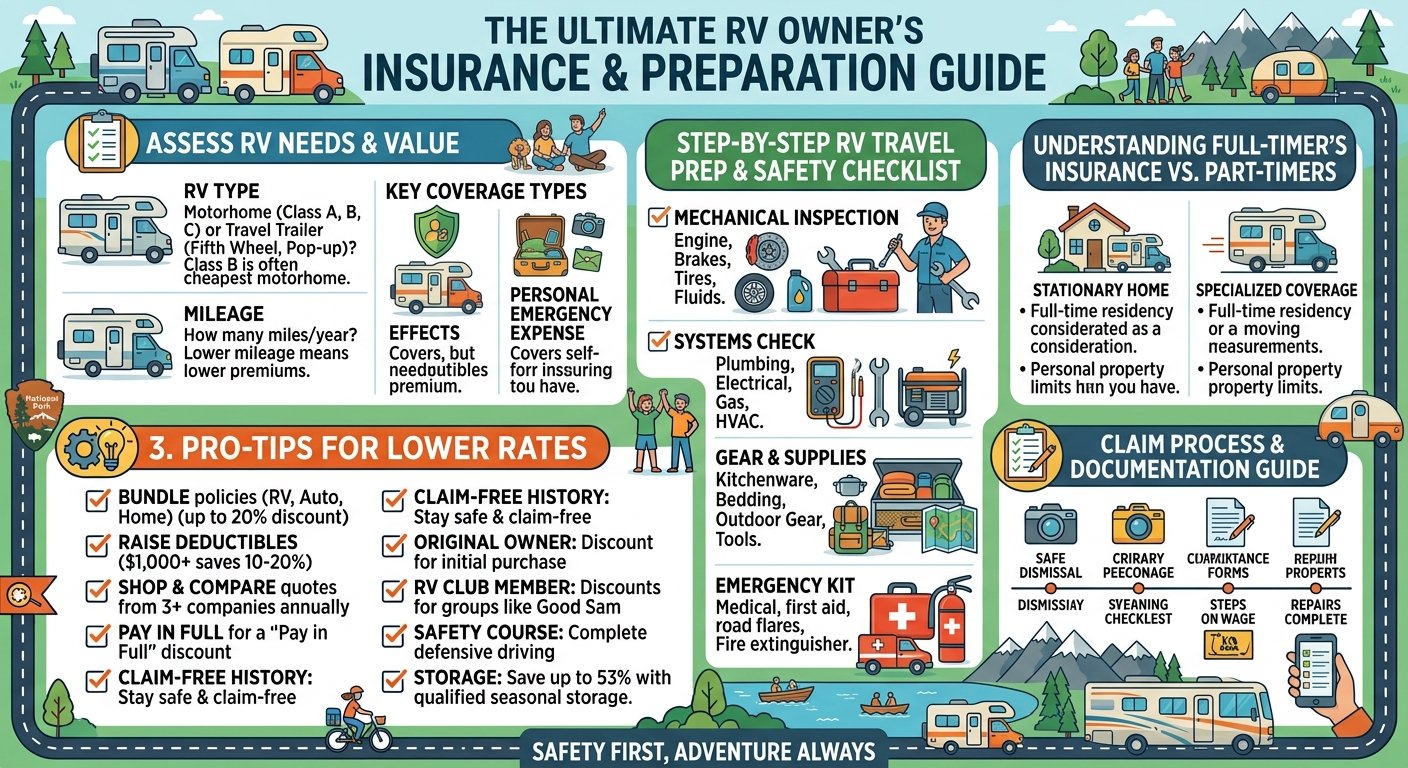
10. 12 Smart Ways to Find Better Coverage at a Lower Price
1. Compare Several Insurers
Don’t accept the first quote.
Request quotes from multiple companies using the same coverage limits and deductibles.
This creates a more meaningful price comparison.
2. Identify Your Camper Correctly
Tell the insurer whether you have a:
- Travel trailer
- Fifth wheel
- Pop-up camper
- Truck camper
- Motorhome
- Camper van
The type of vehicle can affect coverage and pricing.
3. Ask About Multi-Policy Discounts
If you already have home, auto, renters, boat, or motorcycle insurance, ask whether adding camper insurance could create a discount.
Progressive currently lists a multi-policy discount for RV customers who combine qualifying policies.
4. Consider Paying in Full
Some insurers offer a discount when you pay the policy premium in full.
Progressive and other RV insurers currently list pay-in-full savings opportunities.
5. Ask About Storage Discounts
If you only use your camper during certain seasons, ask whether the insurer offers a storage option.
National General currently advertises storage savings of up to 53% for qualifying RV policies.
6. Increase Your Deductible Carefully
A higher comprehensive or collision deductible can often reduce premiums.
But make sure you can afford that deductible after a covered loss.
Progressive specifically recommends considering increased deductibles as one way to reduce RV insurance costs.
7. Maintain a Clean Driving Record
A clean driving history can help you qualify for better rates and safe-driver discounts.
Progressive currently advertises a responsible-driver discount for qualifying customers with no motor-vehicle accidents or violations during the previous three years.
8. Ask About Safety Discounts
Depending on the insurer, safety equipment can help reduce premiums.
Foremost lists factory-installed airbags and anti-lock brakes among its RV discount opportunities.
9. Look for Original-Owner Savings
Some insurers reward the original owner.
Progressive currently offers an original-owner discount for qualifying motorhome and travel-trailer customers who maintain comprehensive and collision coverage.
10. Don’t Overinsure Unnecessary Features
Review optional coverage carefully.
If you have coverage for features or equipment you don’t own, you may be paying for protection that doesn’t match your situation.
Never remove important coverage solely to obtain a lower price.
11. Tell the Insurer How You Actually Use the Camper
Your premium can depend on whether the camper is:
- Used occasionally
- Used seasonally
- Stored for extended periods
- Used as a full-time residence
- Used for business purposes
Foremost specifically offers full-timer coverage for people who live in their RV year-round.
12. Re-Shop Your Policy at Renewal
Your insurance needs and pricing can change over time.
Compare quotes again when:
- Your policy renews
- Your camper becomes older
- You move
- Your driving record improves
- Your usage changes
- You add or remove another vehicle
- You make significant modifications
Don’t assume the company that was cheapest last year will remain cheapest this year.
11. FAQs
Do I need separate insurance for a camper?
It depends on the camper type, state, vehicle use, and existing insurance. A dedicated policy may provide protection that isn’t available under a regular auto or homeowners policy.
How much does camper insurance cost?
Prices vary by camper type, location, value, usage, driver history, coverage, and other factors. Progressive currently advertises qualifying motorhome liability policies starting at $125 per year, but that isn’t a typical price guarantee for every camper.
Does homeowners insurance cover my camper?
It may provide limited protection in specific situations, but homeowners insurance generally should not be assumed to provide complete protection for a camper or RV.
Can I insure a travel trailer?
Yes. Several insurers offer specialized travel-trailer policies. Progressive, Foremost, and National General are examples.
Can I save money while my camper is in storage?
Potentially. Some insurers offer storage-related savings or coverage options. National General currently advertises savings of up to 53% under its storage option for qualifying customers.
Is a higher deductible cheaper?
Generally, raising your comprehensive or collision deductible can lower the premium, but you will have to pay more out of pocket after a covered claim.
Does bundling camper and auto insurance save money?
It can. Progressive and other insurers advertise multi-policy savings, but actual discounts vary by state and customer.
Does camper insurance cover personal belongings?
Some specialized RV policies provide personal-property coverage. National General currently advertises personal belongings protection with an initial $3,000 limit and additional coverage options.
What if I live in my camper full-time?
You may need specialized full-time RV coverage rather than a basic recreational-use policy. Foremost specifically offers full-timer coverage for qualifying customers.
12. Final Verdict
Affordable camper insurance doesn’t necessarily mean choosing the cheapest policy available.
The better strategy is to compare insurers using identical coverage, then investigate legitimate savings such as multi-policy discounts, pay-in-full discounts, storage options, safe-driver discounts, safety-equipment discounts, original-owner discounts, and appropriate deductible levels.
Progressive, Foremost, National General, and Good Sam are examples of companies worth researching for specialized RV and camper coverage. Their official websites can help you check current availability, discounts, and policy options.
The right policy should balance premium, coverage, deductible, exclusions, and the value of your camper.
13. Call to Action
Before purchasing affordable camper insurance, request multiple quotes and compare:
- Annual premium
- Liability limits
- Comprehensive coverage
- Collision coverage
- Personal-property coverage
- Deductible
- Roadside assistance
- Storage options
- Multi-policy discounts
- Safety discounts
- Full-time-use coverage
- Exclusions