
1. Introduction
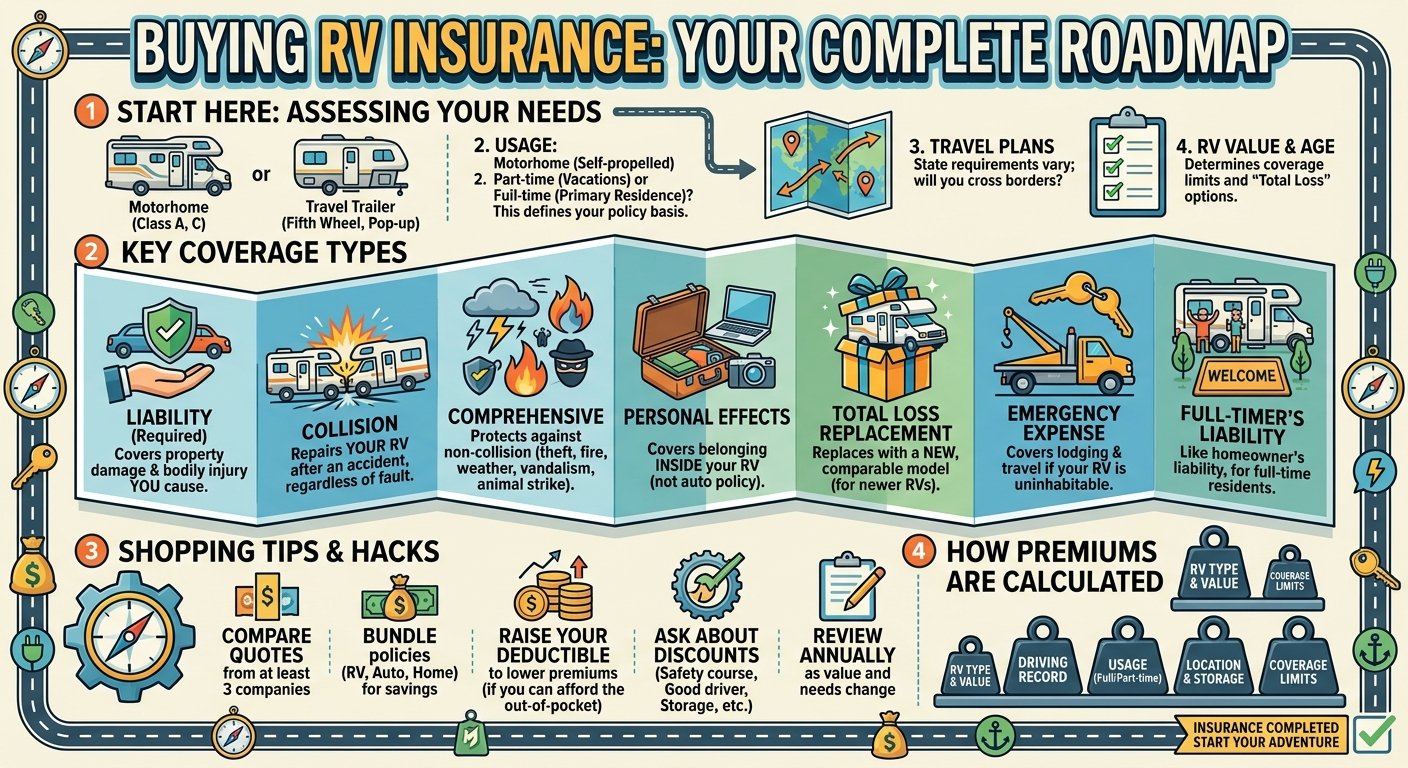
Buying RV insurance is an important step for anyone who owns a motorhome, travel trailer, fifth wheel, pop-up camper, or another recreational vehicle.
An RV can represent a major investment, and ordinary auto or homeowners insurance may not provide all the protection you need. Specialized RV policies can include coverage for the vehicle itself, liability, personal belongings, roadside assistance, emergency expenses, and other risks.
The best policy isn’t necessarily the cheapest one. A better approach is to compare several insurers using similar coverage limits, deductibles, and policy features.
2. What Is RV Insurance?
RV insurance is specialized coverage designed for recreational vehicles. The appropriate policy depends on whether your RV is motorized, towed, used occasionally, or operated as a full-time residence.
Progressive explains that motorhomes generally need motorhome insurance because they are driven, while travel trailers require a different type of RV policy because they are towed. (progressive.com)
Common RV Types
- Class A, B, and C motorhomes
- Travel trailers
- Fifth wheels
- Pop-up campers
- Truck campers
- Camper vans
- Toy haulers
RV Insurance Companies to Compare
| Company | RV Coverage | Published Price / Savings | Official Website |
|---|---|---|---|
| Progressive | Motorhomes, travel trailers, fifth wheels, pop-up campers and more | Qualifying motorhome liability-only policies start at $125/year | Progressive RV Insurance |
| National General | RVs, motorhomes and trailers | Storage option advertises savings up to 53%; RV/auto multi-vehicle savings up to 20% | National General RV Insurance |
| American Family | RVs and travel trailers | Bundling can save up to 26% on auto insurance for qualifying customers | American Family RV Insurance |
| Foremost | Motorhomes, travel trailers, fifth wheels and campers | Multiple discounts and flexible payment plans; individualized pricing | Foremost RV Insurance |
These companies are included for comparison purposes, not endorsements. Rates, discounts, coverage, eligibility, and availability vary by state and customer.
Progressive currently advertises qualifying motorhome liability-only policies starting at $125 per year. Its published 2024 national average was $594 for a travel trailer and $1,052 for a motorhome, although individual premiums can be very different. (progressive.com; progressive.com)
National General currently advertises up to 53% savings through its storage option and up to 20% multi-vehicle savings for qualifying customers. (nationalgeneral.com)
3. Key Features
Liability Coverage
Liability coverage can help with qualifying injuries or property damage for which you are legally responsible.
Comprehensive Coverage
This can cover certain non-collision losses such as theft, fire, vandalism, weather damage, and animal strikes, subject to policy terms. (progressive.com)
Collision Coverage
Collision coverage can help repair or replace an insured RV after qualifying collision damage.
Personal Belongings
Some RV policies provide protection for personal belongings inside the vehicle. National General currently advertises personal belongings coverage with an initial $3,000 limit and additional options. (nationalgeneral.com)
Roadside Assistance
Depending on the insurer, roadside protection can include towing, jump starts, fuel delivery, lockout assistance, and flat-tire service.
Full-Time RV Coverage
If your RV is your primary residence, you may need additional coverage beyond recreational-use insurance.
Progressive notes that people living in an RV six or more months per year may need coverage designed for full-time use. (progressive.com)
4. Benefits
Protects a Major Investment
Specialized insurance can protect the RV against qualifying accidents, theft, weather events, and other covered losses.
Broader Protection Than Basic Auto Coverage
RV policies can include protections specifically designed around recreational vehicles.
Potential Discounts
Insurers may offer discounts based on:
- Bundling
- Safe driving
- Original ownership
- Multiple vehicles
- Claim-free history
- Paying in full
- Continuous insurance
- Safety features
Progressive currently lists all of these types of savings opportunities for qualifying RV customers. (progressive.com)
Storage Savings
If the RV is stored for part of the year, certain insurers may offer specialized storage options.
National General currently advertises savings of up to 53% through its storage option for qualifying policies. (nationalgeneral.com)
5. Pricing
There is no single RV insurance price.
Factors That Affect Your Premium
Insurers may consider:
- RV type
- RV age
- RV value
- Location
- Annual mileage
- Usage
- Driver experience
- Driving history
- Claims history
- Coverage limits
- Deductibles
- Storage arrangements
- Optional coverage
Progressive specifically identifies RV type, location, usage, driving history, and coverage selection as factors affecting cost. (progressive.com)
Published Pricing Examples
| Provider | Published Figure |
|---|---|
| Progressive motorhome liability-only starting price | $125/year |
| Progressive 2024 travel-trailer national average | $594/year |
| Progressive 2024 motorhome national average | $1,052/year |
| Good Sam RV/auto insurance starting price | $15/month |
| National General storage savings | Up to 53% |
Progressive says its $125 starting figure applies to qualifying motorhome liability-only policies. Good Sam’s $15/month figure is an average starting point based on a specific survey of policies produced through its agency and underwritten by carriers in the National General Group. Neither figure is a guaranteed quote. (progressive.com; goodsam.com)
6. Pros & Cons
Pros
| Advantages |
|---|
| Specialized RV protection |
| Multiple coverage choices |
| Potential bundling discounts |
| Possible storage savings |
| Personal-property options |
| Roadside assistance may be available |
Cons
| Potential Drawbacks |
|---|
| Premiums can vary substantially |
| Optional protection increases costs |
| Higher deductibles increase out-of-pocket expenses |
| Full-time use may require additional coverage |
| Coverage differs between insurers |
| Lowest price may mean less protection |
7. Comparison With Alternatives
Specialized RV Insurance
Best for: Owners wanting comprehensive protection specifically designed for RVs.
This usually provides a broader range of RV-specific coverage options.
Standard Auto Insurance
Best for: Limited situations involving a tow vehicle.
Don’t assume your automobile policy provides complete protection for the RV itself.
Homeowners Insurance
Homeowners insurance may provide limited coverage in certain circumstances, but it generally isn’t a substitute for dedicated RV insurance.
Storage Coverage
Best for: RVs that spend significant periods unused.
National General’s storage option is designed to reduce certain coverage costs while the RV is stored and not in use. (nationalgeneral.com)
8. Real User Reviews
What to Look For
When researching RV insurers, look for customer experiences involving:
- Claims handling
- Agent communication
- Billing
- Roadside assistance
- Settlement of total losses
- Personal-property claims
- Policy changes
Use Reviews Carefully
Reviews can help identify patterns, but they don’t predict your individual experience.
Look for reviews specific to RV insurance claims, rather than general reviews of an insurer’s auto products.
Also verify the insurer’s financial strength, licensing, coverage options, and policy terms.
9. Who Should Consider RV Insurance?
Motorhome Owners
Motorhomes are driven vehicles and generally require dedicated motorhome insurance.
Travel-Trailer Owners
Travel trailers are towed and may have different state requirements and insurance considerations.
Fifth-Wheel Owners
Fifth wheels often contain substantial equipment and personal property, making specialized coverage useful.
Full-Time RVers
People using an RV as a residence may need additional liability and personal-property coverage.
Owners With Expensive Equipment
If your RV contains cameras, computers, camping equipment, bicycles, electronics, or other valuables, ask specifically about personal-property limits.
Financed RV Owners
Lenders commonly require comprehensive and collision coverage for financed recreational vehicles. Progressive notes this is common for financed motorhomes and travel trailers. (progressive.com)
10. 12 Smart Steps to Get the Right Coverage at the Right Price
1. Identify Your RV Correctly
Know whether you have a motorhome, travel trailer, fifth wheel, pop-up camper, or another RV.
The insurance product can depend on the vehicle type.
2. Compare Several Insurers
Don’t accept the first quote.
Obtain quotes from multiple companies and compare equivalent coverage.
3. Use Matching Coverage Limits
Make sure each insurer is quoting similar:
- Liability limits
- Collision limits
- Comprehensive coverage
- Personal-property coverage
- Deductibles
Progressive recommends customizing coverage to fit your RV, use, and needs. (progressive.com)
4. Ask About Full-Time Use
Tell the insurer if you live in the RV for six months or more each year.
Full-time RV use can require additional coverage. (progressive.com)
5. Review the Deductible
A higher deductible can reduce the premium, but you’ll pay more out of pocket following a covered loss.
6. Ask About Bundling
Combining RV insurance with home, renters, auto, motorcycle, or boat insurance can create potential savings.
Progressive and American Family currently advertise multi-policy savings for qualifying customers. (progressive.com; amfam.com)
7. Investigate Storage Savings
If your RV spends several months in storage, ask whether an insurer offers a storage-related discount or coverage option.
National General currently advertises savings of up to 53% for qualifying customers. (nationalgeneral.com)
8. Ask About Personal Belongings
Check the limit for belongings inside the RV.
If you carry expensive equipment, ask about additional personal-property coverage.
9. Compare Total-Loss Protection
Ask how the insurer determines your payout after a total loss.
Foremost offers an optional Total Loss Settlement endorsement that may provide a new unit of like kind and quality for qualifying losses. (foremost.com)
10. Check Roadside Assistance
Compare:
- Towing distance
- Tire service
- Fuel delivery
- Lockout service
- Emergency expenses
Roadside coverage can be especially valuable when traveling far from home.
11. Ask About Every Discount
Foremost currently lists multi-policy, airbag, and anti-lock brake discounts, while American Family lists defensive-driving, safety-feature, smart-payment, and bundling opportunities. (foremost.com; amfam.com)
12. Re-Shop at Renewal
Compare your coverage and premium every year or after major changes.
Re-shop when you:
- Buy another RV
- Move
- Change how you use the RV
- Improve your driving record
- Add another insurance policy
- Experience a major premium increase
11. FAQs
How much does RV insurance cost?
It varies considerably. Progressive reports a 2024 national average of $594 for travel trailers and $1,052 for motorhomes on its book of business, while qualifying motorhome liability-only policies start at $125 per year. (progressive.com)
Is RV insurance required?
Requirements vary by vehicle type and state. Progressive notes that motorhomes generally require liability coverage, while travel trailers are treated differently because they aren’t motorized. (progressive.com)
Does auto insurance cover a travel trailer?
Your automobile policy may provide some coverage while towing, but don’t assume it fully protects the trailer. Check your policies and state requirements.
Can I insure a travel trailer?
Yes. Progressive, National General, Foremost, American Family, and other insurers offer travel-trailer or RV insurance options.
Can I save money while my RV is stored?
Potentially. National General currently advertises storage savings of up to 53% for qualifying customers. (nationalgeneral.com)
Do I need special coverage if I live in my RV?
Potentially. Full-time RV users may need additional protections beyond recreational-use coverage.
Does RV insurance cover my belongings?
Some specialized RV policies offer personal-property coverage. Limits and eligible items vary.
Should I choose the cheapest RV policy?
Not necessarily. Compare coverage, deductibles, exclusions, liability limits, personal-property protection, roadside assistance, and total-loss provisions.
Can I bundle RV insurance with my auto policy?
Many insurers offer multi-policy discounts. Progressive and American Family are examples that currently advertise bundling savings. (progressive.com; amfam.com)
12. Final Verdict
Buying RV insurance is about finding the right balance between coverage and cost.
Start by identifying the exact RV type and how you use it. Then compare several insurers using matching coverage limits and deductibles.
Companies such as Progressive, National General, American Family, and Foremost provide specialized RV insurance options and publish different discounts or pricing information on their official websites.
Don’t judge a policy solely by its premium. Review total-loss protection, personal belongings, roadside assistance, liability, deductibles, storage options, and full-time-use requirements.
The right policy should protect both your RV investment and your financial security without paying for coverage that doesn’t match your circumstances.
13. Call to Action
Before purchasing RV insurance, request at least several comparable quotes.
Compare These 12 Items
- RV type
- Annual premium
- Liability limits
- Comprehensive coverage
- Collision coverage
- Personal-property limits
- Deductible
- Total-loss settlement
- Roadside assistance
- Storage options
- Available discounts
- Full-time-use coverage